Thank you for reading the Haofang Chemical Industry Blog!
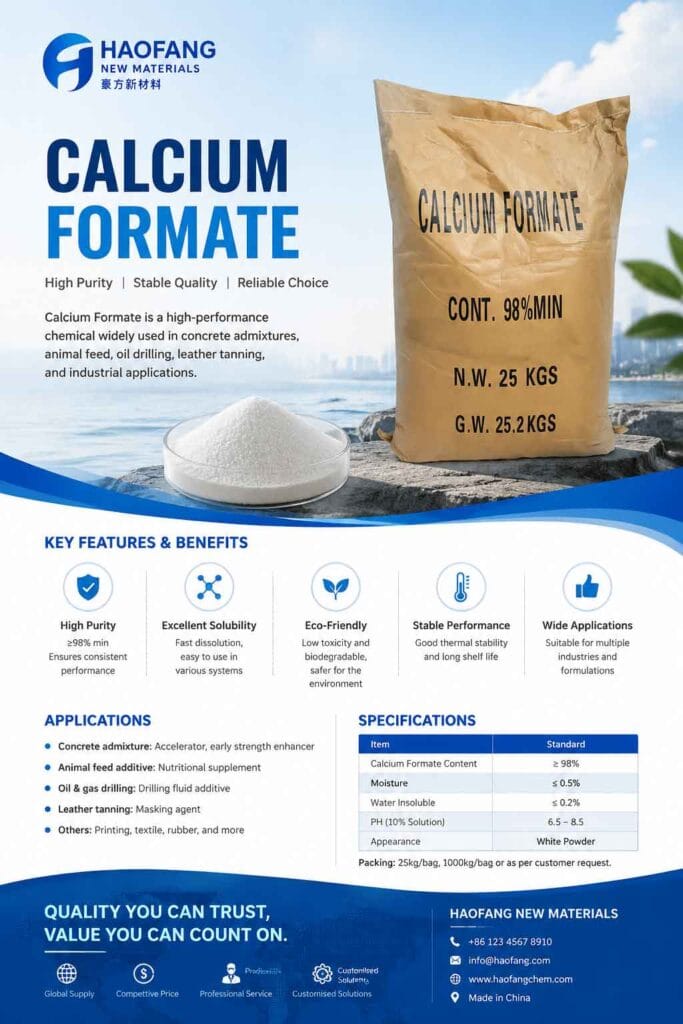
Shijiazhuang Haofang New Material Technology Co., Ltd. is a trusted manufacturer and exporter of chemical raw materials with over 20 years of industry experience. We supply HPMC, CMC, PAC, Sodium Formate, SLES 70%, Calcium Formate, and other industrial chemicals to customers worldwide.
For more industry insights, product updates, and application guides, follow us on:
Facebook: https://www.facebook.com/profile.php?id=61583148969186
YouTube: https://www.youtube.com/@HAOFANGChemicalIndustry
Thank you for your support, and we look forward to helping your business grow with reliable chemical solutions.
Table of Contents
- Calcium formate is commonly used as a non-chloride accelerator in concrete and dry-mix mortar.
- It can shorten setting time and support faster early-strength development.
- Its performance depends on cement chemistry, dosage, temperature, and other admixtures.
- It is particularly useful for precast production, repair work, and cold-weather construction.
- Trial mixes are essential before confirming a dosage for commercial production.
- Buyers should evaluate purity, moisture, particle size, packaging, and batch consistency.
Concrete producers often need to improve early strength without introducing excessive chloride into the mix. Faster strength development can shorten demolding cycles, support winter construction, and reduce delays in precast or repair projects. This is where calcium formate can provide practical value.
As a cement accelerator, calcium formate influences hydration during the early curing stage. However, it is not a universal additive with one fixed dosage. Its effectiveness must be assessed against the cement type, mix design, ambient temperature, and performance target.
This guide explains how calcium formate in concrete works, where it is used, how it compares with other accelerators, and what buyers should evaluate before placing an order.
What Is Calcium Formate?
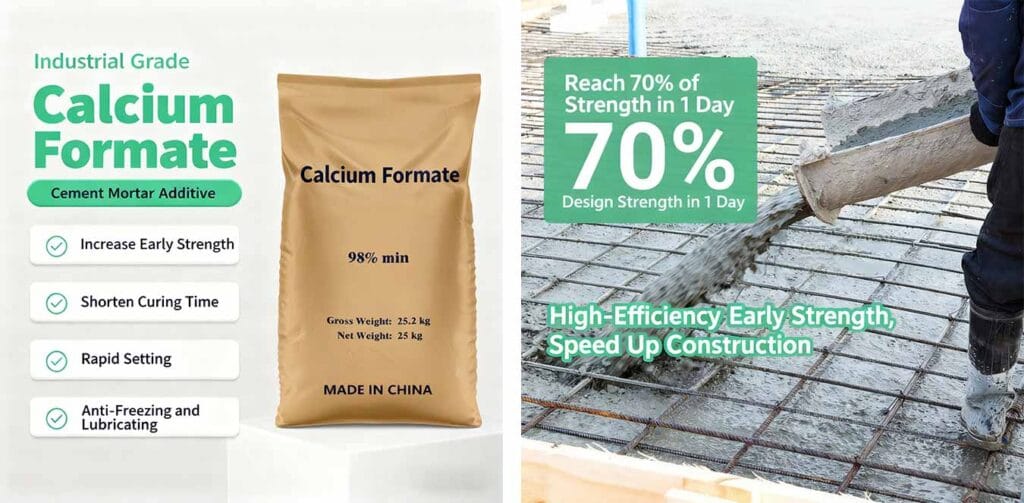
Calcium formate is the calcium salt of formic acid, with the chemical formula Ca(HCOO)₂ and CAS number 544-17-2. Commercial material is generally supplied as a white, free-flowing crystalline powder.
In cement-based formulations, it is mainly used as an early-strength agent and setting accelerator. Buyers can review Haofang’s calcium formate product specifications for its common construction and industrial applications.
Calcium Formate as an Accelerator
An accelerator changes the rate at which cement reacts with water. Depending on the formulation, it may reduce setting time, improve early compressive strength, or provide both effects.
These two functions should not be treated as identical. A material that shortens initial set does not necessarily deliver the same increase in one-day strength.
Setting Acceleration
Setting acceleration helps fresh concrete become rigid sooner. It is valuable when contractors need shorter finishing windows, rapid repair turnaround, or earlier protection against cold conditions.
Early-Strength Acceleration
Early-strength acceleration supports faster load-bearing development during the first hours or days. This can help precast manufacturers remove molds sooner and improve production efficiency.
How Does Calcium Formate Work in Concrete?
When cement contacts water, several mineral phases begin to dissolve and form hydration products. Calcium formate alters the early hydration environment, helping some cement reactions proceed more rapidly.
Research published in Cement and Concrete Research found that suitable additions shortened setting time and increased early compressive strength in the cement systems tested. The study also showed that performance varied with cement composition and dosage, highlighting the need for project-specific testing. Readers can review the calcium formate accelerator study for further technical context.
Influence on Cement Hydration
The formate ions interact with the aqueous phase around cement particles, while calcium ions contribute to the ionic environment of the paste. These effects can promote earlier formation of strength-producing hydration products.
The precise response depends on the proportions of clinker phases and supplementary cementitious materials. Two cement sources may therefore react differently to the same additive level.
Early C-S-H Formation
Calcium silicate hydrate, commonly abbreviated as C-S-H, is the principal binding phase responsible for much of concrete’s strength. Accelerated hydration can support earlier formation of this binding structure.
This does not mean that adding more accelerator always creates better concrete. Excessive acceleration may reduce workable time or produce an unbalanced strength profile.
Key Benefits of Calcium Formate in Concrete
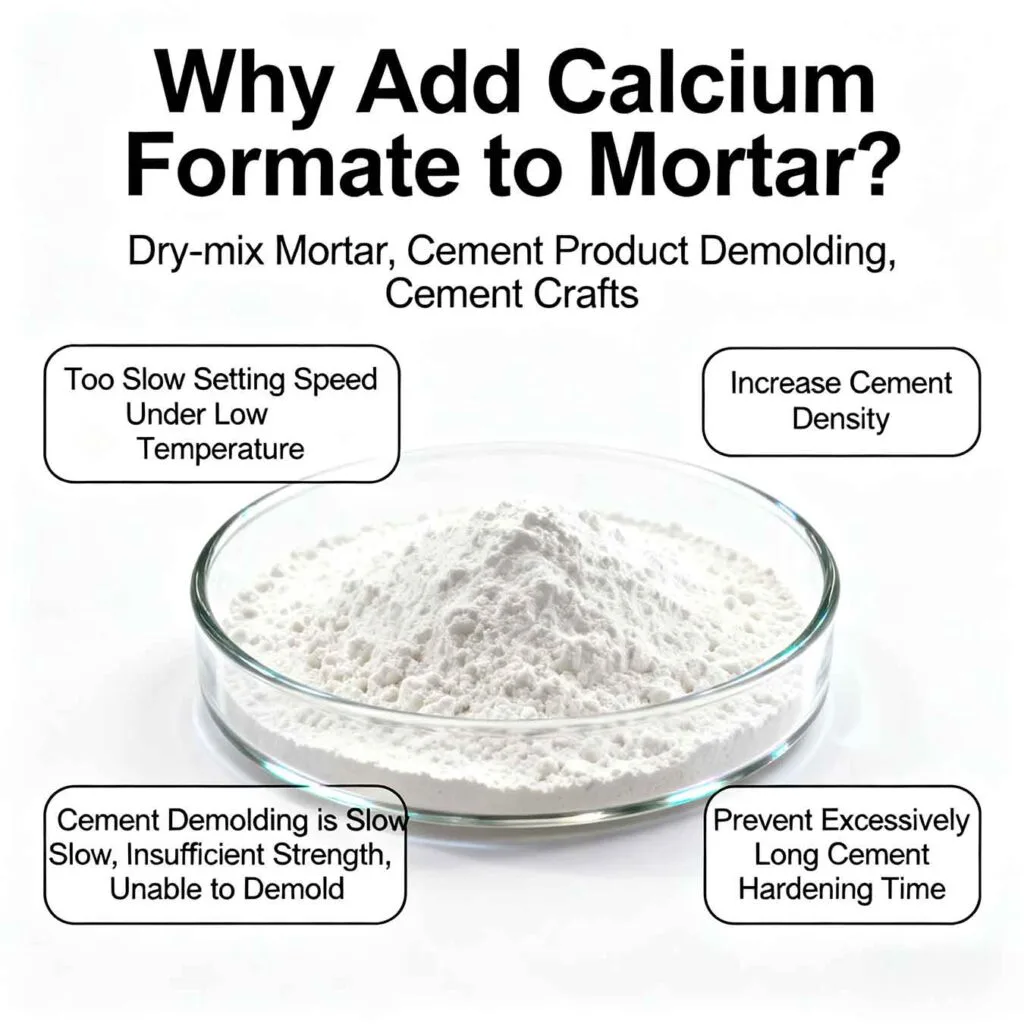
The main commercial value comes from improving early-stage performance. The actual benefits depend on whether the additive is compatible with the full concrete formulation.
Faster Early-Strength Development
Faster strength gain can allow earlier demolding, handling, transportation, or reopening of repaired areas. This is especially relevant in precast plants where mold utilization affects daily output.
The improvement should be confirmed through strength testing at relevant ages, such as 8 hours, 24 hours, three days, and 28 days. Testing only the final strength can overlook the reason for using the accelerator.
Shorter Setting Time
A controlled reduction in setting time can help projects that require rapid finishing or fast turnaround. It may also reduce long waiting periods under cool conditions, where normal hydration proceeds more slowly.
Contractors should still monitor placement and finishing time. If the mix sets too quickly, the supposed productivity benefit can become a workability problem.
Low-Temperature Construction Support
Cold weather slows cement hydration and delays strength development. An accelerator can help concrete gain early strength faster, but it does not replace correct cold-weather concreting practices.
Concrete temperature, heated materials, insulation, and curing protection remain essential. The American Concrete Institute’s cold-weather guidance provides additional information on protecting concrete at low temperatures.
Chloride-Free Formulation Option
Calcium chloride is a highly effective and economical accelerator, but chloride ions can increase corrosion risk for embedded steel. This limits its suitability in many reinforced and prestressed applications.
Calcium formate provides a chloride-free alternative for formulators who want to accelerate early hydration. Compliance must nevertheless be assessed according to the applicable project specification and local standard.
Common Applications of Calcium Formate
Its use extends beyond ordinary ready-mix concrete. It is particularly relevant to factory-made and dry-blended construction products where accurate powder dosing is possible.
Precast Concrete Products
Precast plants depend on predictable cycle times. Faster early strength may permit earlier mold stripping and increase the number of production cycles completed with the same equipment.
Common applications include blocks, panels, pavers, curbs, and other molded cement products. Each product should be tested for surface quality, dimensional stability, and strength before full-scale production.
Dry-Mix Mortar
Dry-mix manufacturers can blend the powder directly with cement, sand, polymers, and other additives. This makes controlled distribution easier than manual addition on a construction site.
Potential applications include repair mortar, masonry mortar, non-shrink grout, and selected rendering systems. Haofang also supplies a broader range of construction additives for cement-based formulations.
Tile Adhesives
In tile adhesives, controlled early strength can support faster curing and earlier subsequent work. The additive must be balanced carefully with cellulose ether and redispersible polymer powder.
Too much acceleration can shorten open time and reduce the practical installation window. The complete formulation, rather than one ingredient alone, determines application performance.
Rapid-Repair Concrete
Road repairs, industrial floors, and maintenance projects often require short closure periods. Calcium formate may contribute to a faster return to service when used in a properly designed repair formulation.
A Practical Limitation
Rapid setting is not the same as rapid service readiness. Compressive strength, bond strength, shrinkage, curing conditions, and expected load must all be evaluated.
Calcium Formate Dosage in Concrete
There is no universal dosage suitable for every cement system. Laboratory research has examined levels such as 0.25%, 0.50%, and 0.75% by cement mass, while commercial formulations may require different levels.
These figures should be treated as trial ranges, not as a final production instruction. The correct amount must be established through controlled tests using the project’s actual cement, aggregates, water, and admixtures.
Factors That Change the Required Dosage
Cement Composition
The proportions and reactivity of cement minerals affect accelerator response. Cement fineness and supplementary materials such as fly ash, slag, or silica fume can also change early hydration.
Curing Temperature
A dosage that performs well at 20°C may not produce the same result at 5°C. Low-temperature testing should therefore reproduce realistic production and site conditions.
Water-to-Cement Ratio
Changes in water content affect concentration, workability, porosity, and strength. Accelerator trials should use the intended water-to-cement ratio rather than a simplified laboratory paste alone.
Other Admixtures
Water reducers, retarders, air-entraining agents, polymers, and cellulose ethers may interact with the accelerator. Compatibility testing is necessary when several admixtures are used together.
Recommended Trial Procedure
- Prepare a control mix without an accelerator.
- Test several low-to-moderate dosage levels.
- Measure slump or flow retention at planned intervals.
- Record initial and final setting times.
- Test early and later-age compressive strength.
- Check air content, surface quality, shrinkage, and durability requirements.
- Repeat the preferred formulation using another material batch.
This approach identifies whether the performance is repeatable rather than the result of a single favorable test.
Calcium Formate vs Other Concrete Accelerators
Different accelerators solve different production problems. Selection should consider reinforcement, required speed, temperature, compatibility, cost, and local standards.
| Accelerator type | Main advantage | Main limitation | Typical selection consideration |
|---|---|---|---|
| Calcium formate | Chloride-free and suitable for dry blends | Performance varies with cement chemistry | Reinforced concrete, dry mortar, and precast products |
| Calcium chloride | Strong acceleration and relatively low cost | May increase steel corrosion risk | Generally restricted in reinforced or prestressed concrete |
| Calcium nitrate | Chloride-free and used in commercial admixtures | May cost more and behave differently by dosage | Reinforced concrete and cold-weather mixes |
| Calcium nitrite | Acceleration plus corrosion-inhibiting applications | Higher formulation cost | Reinforced structures requiring corrosion protection |
| Aluminum-based accelerator | Very rapid setting | Can reduce workable time and affect later properties | Shotcrete and specialized rapid-setting systems |
Calcium Formate vs Calcium Chloride
Calcium chloride often accelerates concrete more aggressively and may be more economical. Its chloride content, however, creates a significant limitation when steel reinforcement is present.
Calcium formate is frequently considered when a formulator needs a non-chloride powder accelerator. Buyers should not assume that the two materials can be substituted at the same dosage.
Calcium Formate vs Calcium Nitrate
Both are used in chloride-free systems, but they differ in physical form, solubility, dosing method, and interaction with cement. Calcium formate is especially convenient for factory-produced dry mixes.
Calcium nitrate is often supplied as part of a liquid admixture system. The better choice depends on production equipment and the required concrete performance.
Does Calcium Formate Affect Workability?
Acceleration can reduce the time available for mixing, transporting, placing, and finishing. At an appropriate dosage, the change may be manageable; at an excessive level, slump loss or premature stiffening can become a problem.
Recent research on reactive powder concrete has also shown that the relationship between formate additives and flow is formulation-dependent. This reinforces the need to evaluate setting time and workability together rather than optimizing only early strength.
How to Control Workability Loss
Start with the lowest dosage that meets the required early-strength target. Then assess compatibility with the selected superplasticizer under realistic mixing and temperature conditions.
Avoid Adding Extra Water
Adding water at the job site to recover slump can increase the water-to-cement ratio and reduce final performance. Workability should be managed through mix design and compatible admixtures.
Potential Limitations and Common Mistakes
Calcium formate can be effective, but improper use may create inconsistent or undesirable results.
Using a Dosage Without Testing
Supplier guidelines are useful for initial screening, but they cannot represent every cement source. A dosage copied from another formulation may change setting, strength, or workability in unexpected ways.
Focusing Only on One-Day Strength
A strong one-day result does not confirm acceptable long-term performance. The mix should also be assessed for later strength, shrinkage, permeability, freeze-thaw exposure, and other project requirements.
Ignoring Moisture and Caking
The powder should be protected from moisture during storage and transportation. Moisture uptake can cause caking and make accurate dispersion more difficult.
Confusing Acceleration With Antifreeze Protection
An accelerator may help concrete develop strength sooner, but it does not allow fresh concrete to freeze safely. Cold-weather protection and appropriate curing remain necessary.
How to Choose Calcium Formate for Concrete
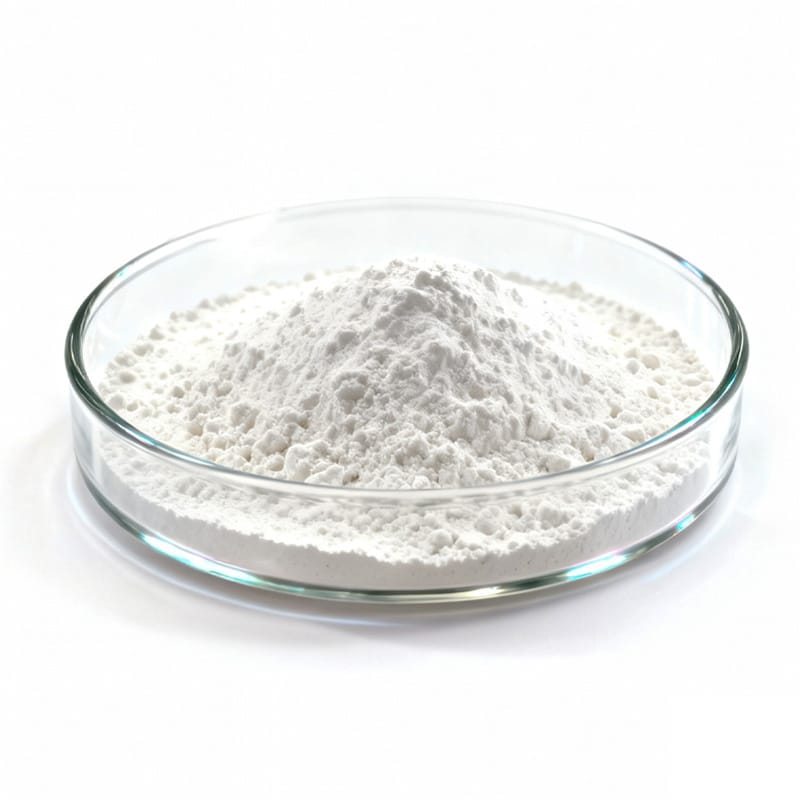
Procurement decisions should be based on technical consistency as well as price. An inexpensive material can create higher production costs if its purity or moisture varies between shipments.
Purity and Active Content
Ask the supplier to state the calcium formate content and test method. Higher stated purity is useful only when it is supported by consistent batch documentation.
Moisture Content
Low and controlled moisture supports free-flowing behavior and more reliable dry blending. Packaging should include an effective moisture barrier.
Particle Size and Dispersion
Particle size influences powder flow and distribution in dry mixes. Buyers should check whether the material can be dispersed evenly with their existing mixing equipment.
Batch-to-Batch Consistency
Concrete and mortar manufacturers require predictable behavior. Review certificates of analysis from multiple batches instead of relying on a single sample.
Documentation and Packaging
Request a technical data sheet, safety data sheet, certificate of analysis, packaging details, shelf-life guidance, and export documentation. Haofang offers calcium formate in 25 kg bags and 1,000 kg bulk bags for different production and logistics requirements.
Buyers evaluating a new source can also follow this chemical raw material sourcing guide to review supplier quality control, samples, documentation, and delivery capability.
Final Thoughts
Calcium formate in concrete is valuable when producers need faster early hydration, shorter setting time, or improved low-temperature productivity without adding chloride. Its applications include precast concrete, rapid-repair products, dry-mix mortar, grout, and tile adhesives.
The best results come from treating it as part of a complete mix design. Cement chemistry, temperature, water content, polymers, and other admixtures all influence performance. Controlled laboratory trials followed by production-scale verification are therefore essential.
For product specifications, samples, packaging options, or technical discussions, contact Haofang Chemicals to evaluate a suitable grade for your concrete or dry-mix formulation.
FAQ
What does calcium formate do to concrete?
It is mainly used to accelerate cement hydration, shorten setting time, and improve early-strength development. The exact result depends on dosage, cement composition, temperature, and other admixtures.
How much calcium formate should I add to concrete?
There is no single dosage for all concrete. Published studies have evaluated several dosage levels based on cement mass, but manufacturers should conduct trial mixes to determine the lowest amount that meets their performance target.
Can calcium formate be used in reinforced concrete?
It is a non-chloride accelerator and is often considered for reinforced systems where chloride addition is restricted. The final mix must still comply with the relevant concrete standard and project specification.
Is calcium formate suitable for winter concrete?
It can support earlier strength gain when temperatures are low, but it is not a substitute for heating, insulation, temperature monitoring, and proper curing. Fresh concrete must still be protected from freezing.
Will calcium formate reduce concrete setting time?
It can shorten initial and final setting times when it is compatible with the cement system. The level of reduction cannot be predicted accurately without testing the actual formulation.
Does calcium formate increase 28-day strength?
Its clearest benefit is normally early-age performance. Later strength may remain stable or change depending on cement type, dosage, curing, and mix design, so 28-day testing remains necessary.
Can it be used with a superplasticizer?
Often yes, but compatibility is not automatic. The combination should be tested for flow retention, setting behavior, air content, and strength before commercial use.
Is calcium formate the same as calcium chloride?
No. Both can accelerate cement systems, but they have different chemistry, dosage behavior, and corrosion considerations. Calcium formate does not introduce chloride ions into the formulation.
Is calcium formate suitable for dry-mix mortar?
Yes. Its powder form makes it suitable for controlled blending into tile adhesives, repair mortars, grouts, and other factory-produced cement systems.
What should I request from a calcium formate supplier?
Ask for the product specification, certificate of analysis, safety data sheet, sample, packaging information, lead time, and evidence of batch consistency. The sample should be tested in your own formulation before bulk purchasing.