Table of Contents
Key Takeaways
- Sodium formate is used in drilling, drill-in and completion fluid systems where a soluble formate salt is required.
- Formate brines can provide density without relying entirely on suspended solid weighting materials.
- Sodium formate, potassium formate and cesium formate cover different achievable brine-density ranges, so they should not be selected interchangeably.
- Sodium formate is particularly useful in lower- to medium-density formate systems, while potassium formate becomes more relevant when greater density or stronger potassium-based shale inhibition is required.
- Brine density alone is not enough to select a drilling fluid. Formation mineralogy, bottom-hole temperature, fluid-loss control, corrosion, crystallization risk and reservoir compatibility also matter.
- Formate salts are often used alongside polymers such as PAC to control filtration and rheology.
- Buyers should define the intended drilling environment before selecting purity, physical form, packaging and associated drilling-fluid additives.
Introduction
Modern drilling fluids have to perform several functions at the same time. They must support hydrostatic pressure, transport cuttings, help stabilize the wellbore, control filtration and remain manageable across changing temperature and pressure conditions.
This is why the choice of base fluid and dissolved salts has a major influence on the complete drilling-fluid system.
Sodium Formate is one of the formate salts used in industrial drilling applications. Haofang currently supplies sodium formate as a white crystalline powder with a stated purity range of 92–99%, with drilling fluids among its major application areas.
For drilling engineers and chemical procurement teams, however, understanding that sodium formate can be used in drilling fluid is only the starting point.
The more useful questions are:
Why are formate brines used?
How much density can sodium formate provide?
When should potassium formate be considered instead?
How does the brine interact with polymers such as PAC?
And which specifications should be checked before a commercial order?
This guide answers those questions from an industrial formulation and sourcing perspective.
What Is a Sodium Formate Drilling Fluid?
Sodium formate has the chemical formula HCOONa. When dissolved in water at an appropriate concentration, it can form a clear formate brine suitable for selected drilling, drill-in and completion-fluid applications.
The SLB Energy Glossary identifies three alkali-metal formates commonly used in these systems:
- Sodium formate
- Potassium formate
- Cesium formate
SLB reports that clear solutions of these salts can reach approximate densities of 1.32 g/cm³ for sodium formate, 1.58 g/cm³ for potassium formate and 2.4 g/cm³ for cesium formate.
That density difference immediately explains one of the most important selection principles.
Sodium formate is not simply a cheaper or lighter version of potassium formate. Each salt occupies a different useful density range and may provide different operational advantages.
What Is a Formate Brine?
A formate brine is a concentrated aqueous solution containing formate salts.
Unlike a conventional weighted drilling mud that may rely heavily on suspended solids to increase density, a formate brine can obtain substantial density from dissolved salts.
According to SLB’s clear-brine technical information, formate salts are highly soluble and can create high-density, solids-free brines, reducing the need for conventional weighting materials in suitable systems.
This characteristic is especially relevant in reservoir drill-in and completion environments where suspended solids and formation interaction must be carefully controlled.
Why Is Sodium Formate Used in Drilling Fluids?
The value of sodium formate comes from the way a concentrated formate solution behaves as part of the complete fluid system.
It should not be viewed as a single additive that independently solves every drilling-fluid problem.
Instead, it provides a brine environment that can support several formulation objectives.
1. Density Without Large Amounts of Suspended Weighting Solids
Hydrostatic pressure is one of the fundamental requirements in drilling and completion operations.
In conventional mud systems, density may be increased with weighting materials. These particles are useful in many applications, but solids can also introduce concerns such as settling, filtration behavior and possible reservoir invasion.
Formate brines provide another route.
Because the salt is dissolved rather than suspended, the fluid can achieve useful density while remaining a clear brine under suitable formulation conditions. SLB specifically describes sodium, potassium and cesium formates as bases for high-density solids-free brine systems.
For lower-density formate requirements, sodium formate can therefore be an attractive starting material.
2. Wellbore and Shale Stability
Water-sensitive shale can create significant drilling challenges.
Contact with an unsuitable water-based fluid may contribute to hydration, swelling, dispersion or weakening of reactive clay-rich formations.
The chemistry of the brine is consequently important.
SLB notes that formate-brine systems are used with shale-stabilization objectives and can help reduce potential formation damage when properly engineered.
This does not mean sodium formate alone guarantees wellbore stability.
Performance depends on concentration, formation type, other ions, polymers, fluid-loss additives and the complete drilling program.
3. Compatibility With Solids-Free Completion Systems
Clear completion fluids are designed to provide hydrostatic pressure without introducing unnecessary suspended material into the reservoir interval.
A 2024 open-access study in Scientific Reports evaluated several brine systems for completion applications, including formate chemistry, and emphasized that fluid selection should consider density, temperature stability, formation compatibility, clay interaction and wettability rather than only one laboratory property.
This is a useful purchasing lesson.
A drilling-fluid raw material cannot be evaluated independently from the reservoir environment in which it will operate.
4. Compatibility With Other Functional Additives
Brine density is only one part of drilling-fluid performance.
The complete formulation may also require:
- Filtration control
- Viscosity adjustment
- Cuttings suspension
- Lubricity
- Shale inhibition
- pH control
- Corrosion management
- High-temperature stability
This is why formate salts are commonly evaluated together with other Oil Drilling Chemicals rather than as isolated products.
Haofang’s oil-drilling range currently includes formate chemistry as well as products such as Polyanionic Cellulose and PAC-HV for viscosity and filtration-control applications.
Sodium Formate vs Potassium Formate in Drilling Fluids
The question is not which material is universally better.
The correct choice depends largely on the required density and the behavior expected from the brine system.
| Selection Factor | Sodium Formate | Potassium Formate |
|---|---|---|
| Chemical formula | HCOONa | HCOOK |
| Main cation | Sodium | Potassium |
| Approx. maximum clear-solution density reported by SLB | 1.32 g/cm³ | 1.58 g/cm³ |
| Typical role | Lower/medium-density formate systems | Higher-density formate systems |
| Drilling use | Drilling, drill-in and completion fluids | Drilling, drill-in and completion fluids |
| Shale-sensitive systems | Requires formation-specific evaluation | Potassium chemistry can be advantageous in selected shale systems |
| Can be blended with other formates | Yes | Yes |
| Selection priority | Density, compatibility, temperature, formulation | Density, shale interaction, temperature, formulation |
The density figures above come from SLB’s technical definition of formate fluids. Actual field formulations must account for concentration, temperature, crystallization behavior and the rest of the fluid system.
When Sodium Formate Makes More Sense
Sodium formate is particularly worth evaluating when the required fluid density remains within a range that can be achieved without moving to a heavier formate salt.
It may also be selected when the formulation already has a validated sodium-formate basis and the formation does not specifically require the chemical benefits associated with a potassium-rich environment.
This is why the first question should be:
“What fluid density and formation response do we need?”
rather than:
“Which formate salt should we purchase?”
When Potassium Formate Becomes More Relevant
Potassium Formate can reach higher brine density than sodium formate and is widely used in drilling and completion fluids. Haofang currently lists ≥96% and ≥98% grades and positions the product for high-density brine and oilfield applications.
It can therefore become the more logical option when the density requirement exceeds the practical sodium-formate range.
Formation behavior may also affect the choice.
Potassium-containing systems are frequently evaluated for water-sensitive shale because potassium ions can contribute to clay-inhibition strategies, although the result remains dependent on formation mineralogy and fluid composition.
Can Sodium and Potassium Formate Be Used Together?
Yes.
A drilling formulation does not necessarily need to choose only one formate salt.
SLB notes that formates can generally be blended across broad concentration ranges, and actual field systems have used mixed sodium/potassium formate formulations.
This makes blending useful when a formulation engineer wants to adjust density and other fluid properties more precisely.
A real field example is documented in an SLB sodium/potassium formate case study.
In that project, a mixed sodium-potassium formate reservoir drill-in fluid was used in high-temperature wells in Saudi Arabia. The documented system operated at required densities of approximately 1.38–1.41 specific gravity and expected bottom-hole temperatures reaching 340°F (171°C).
The important lesson is not to copy that formulation.
It is that formate selection can be engineered as a system rather than limited to a single salt.
How Does Sodium Formate Work With PAC?
A high-quality brine does not automatically provide suitable rheology or filtration control.
This is where polymer additives become important.
Polyanionic Cellulose is commonly used in water-based drilling fluids as a fluid-loss reducer and viscosity modifier. Haofang lists PAC-LV and PAC-HV types for filtration and rheology adjustment.
Sodium Formate Provides the Brine Environment
Its main formulation contribution is the dissolved formate salt system and associated brine properties.
PAC Controls Filtration and Rheology
PAC can help:
- Reduce filtrate loss
- Modify viscosity
- Improve suspension
- Support cuttings transport
- Assist with stable filter-cake formation
For formulations requiring stronger viscosity development, Polyanionic Cellulose PAC-HV is designed as the higher-viscosity option.
The two ingredients therefore perform different functions.
Sodium formate should not be expected to replace a dedicated filtration-control polymer, just as PAC should not be expected to provide the same density contribution as a concentrated formate brine.
What Determines the Right Sodium Formate Concentration?
There is no universal sodium formate dosage that works for every drilling fluid.
The appropriate concentration must be determined from the target brine properties and the complete fluid design.
Several factors deserve particular attention.
Target Fluid Density
This is usually the starting point.
The fluid must provide adequate hydrostatic pressure for the intended well conditions without creating unnecessary overbalance or operational complications.
If the required density is above the practical sodium-formate range, the engineer may consider potassium formate, mixed formates or another completion-fluid system.
Temperature
Temperature affects brine behavior, polymer performance, viscosity and crystallization margins.
A formulation suitable at surface conditions may behave differently downhole.
Laboratory testing should therefore reflect the expected operational temperature rather than only room-temperature performance.
Crystallization Temperature
Highly concentrated brines require attention to crystallization.
Transportation, storage, mixing and field temperatures all need to remain within an acceptable operating window.
If a concentrated salt solution approaches its crystallization limit, field handling can become significantly more difficult.
Formation Mineralogy
Shale, sandstone and carbonate formations do not respond identically to the same brine.
Clay content and water sensitivity should be evaluated when choosing both the salt and the additive package.
The Scientific Reports completion-fluid study reinforces this point by showing that different brine compositions produced different clay-swelling and wettability responses.
Polymer Compatibility
PAC, xanthan gum, starch derivatives and other polymers can respond differently as salinity and temperature change.
A formulation therefore needs to be tested as a complete system.
A polymer that performs well in freshwater cannot automatically be assumed to perform identically in concentrated sodium or potassium formate brine.
Sodium Formate Selection Matrix for Drilling Applications
| Operating Requirement | What to Evaluate |
| Moderate clear-brine density | Sodium formate concentration and crystallization margin |
| Higher brine density | Potassium formate or blended formate system |
| Reactive shale | Formation testing and potassium-based inhibition strategy |
| Strict fluid-loss control | PAC-LV, PAC-HV or compatible filtration-control system |
| Higher temperature | Polymer thermal stability and full-system aging tests |
| Reservoir drill-in fluid | Formation compatibility and solids control |
| Completion fluid | Density, compatibility, corrosion and reservoir protection |
| Low-temperature logistics | Crystallization and handling temperature |
| Recycled brine system | Contamination and property verification |
This matrix is intended as a screening tool. Final formulation decisions should be based on laboratory and field validation.
What Specifications Should Buyers Check?
The keyword “sodium formate” may look like a commodity search, but drilling-fluid procurement requires more detail than simply confirming the chemical name.
Purity
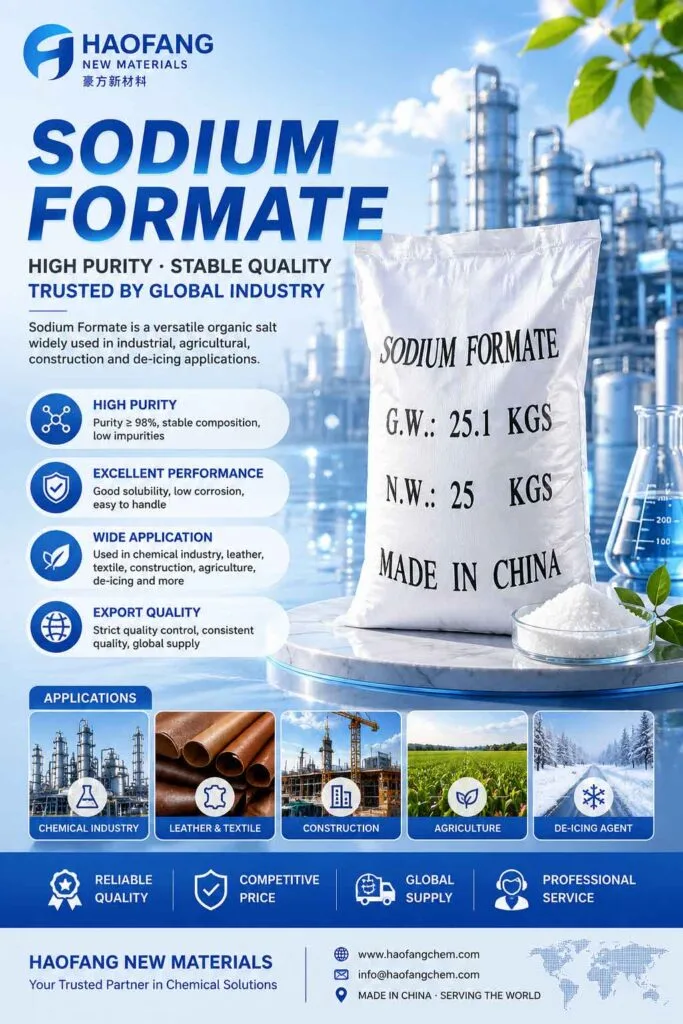
Haofang’s current Sodium Formate product range lists 92–99% purity. Different applications may therefore require different grade selection.
A buyer should specify the required grade rather than assume every commercial sodium formate product has identical active content.
Moisture
Moisture affects effective concentration, storage behavior and the quantity needed to prepare a target brine.
For concentrated systems, variation between batches can complicate brine preparation.
Insoluble Matter
A drilling-fluid customer may be particularly concerned about unwanted insoluble material when the final objective is a clean brine system.
The supplier specification should therefore be reviewed for the intended application.
Chloride and Other Ions
Impurities may influence corrosion, fluid compatibility and downstream performance.
Rather than evaluating purity alone, buyers should examine the impurity profile that matters to their formulation.
Physical Form
Powder or crystalline characteristics affect:
- Dissolution rate
- Dust handling
- Feeding
- Mixing time
- Storage
- Packaging efficiency
The preferred physical form depends on plant and field handling systems.
Batch Consistency
Drilling formulations are easier to manage when incoming raw material properties remain predictable.
For repeated commercial purchases, comparing COAs across multiple production batches can provide more useful information than evaluating a single sample.
Practical Pre-Purchase Testing
Before scaling from a sample to bulk supply, a drilling-fluid team should reproduce the intended field formulation as closely as practical.
Useful testing can include:
- Prepare the required formate-brine concentration.
- Measure density under the relevant test conditions.
- Evaluate crystallization behavior where low-temperature exposure is possible.
- Add the planned PAC or other polymer package.
- Measure rheological properties.
- Test filtration performance.
- Conduct thermal aging at representative temperature.
- Evaluate shale or formation compatibility when relevant.
- Check corrosion requirements for the intended equipment and metallurgy.
- Compare the results with production or field acceptance limits.
This approach creates far more useful procurement data than simply asking whether a sample “looks good.”
Building a Complete Oil Drilling Chemical System
A high-performance fluid typically depends on several raw materials working together.
For customers already evaluating sodium formate, Haofang’s Oil Drilling Chemicals category also includes:
- Potassium Formate for higher-density formate brines
- Polyanionic Cellulose for filtration and rheology control
- PAC-HV for higher-viscosity drilling-fluid systems
- Polyacrylamide PAM for selected water-soluble polymer applications
This creates a more useful sourcing approach for formulators.
Instead of purchasing each chemical as an unrelated raw material, the technical team can evaluate how brine salts and functional polymers interact within the complete drilling-fluid system. Haofang’s oil-drilling category currently groups potassium formate, PAC products and other drilling additives within the same product cluster.
Conclusion
Sodium formate is valuable in drilling fluids because it can serve as the basis of a soluble formate-brine system while contributing useful density without depending entirely on suspended weighting solids.
But its successful use depends on much more than dissolving sodium formate in water.
The drilling team must evaluate target density, formation mineralogy, temperature, crystallization risk, polymer compatibility, fluid-loss requirements and reservoir conditions.
When higher density is required, Potassium Formate or a blended formate system may be more suitable. When filtration and rheology become priorities, additives such as Polyanionic Cellulose can be incorporated according to the final fluid design.
SLB’s technical information confirms that sodium, potassium and cesium formates are established bases for drilling, drill-in and completion-fluid brines, while field applications demonstrate that mixed formate systems can also be engineered for demanding well conditions.
For drilling-fluid manufacturers, service companies and industrial chemical distributors, the best sourcing decision therefore begins with the required fluid properties rather than the chemical name alone.
For specific purity, packaging or application requirements, review Haofang’s Sodium Formate specifications or contact the Haofang team to discuss the intended drilling-fluid system.
FAQ
Why is sodium formate used in drilling fluids?
Sodium formate can be dissolved to produce a clear formate brine that provides useful fluid density without requiring the same level of suspended weighting solids as conventional weighted mud. It is used in selected drilling, drill-in and completion systems where density, formation compatibility and brine performance are important.
Is sodium formate better than potassium formate for drilling?
Neither is universally better. Sodium formate is suitable for lower-density formate systems, while potassium formate can achieve higher brine density and may provide advantages in some shale-sensitive formations. The correct choice depends on required density, temperature, formation chemistry and the complete additive package.
What density can sodium formate brine reach?
SLB reports that clear sodium formate solutions can reach approximately 1.32 g/cm³, compared with about 1.58 g/cm³ for potassium formate and 2.4 g/cm³ for cesium formate. Actual operating density and crystallization limits must be confirmed for the specific concentration and temperature.
Can sodium formate be used together with PAC?
Yes. The materials perform different functions in the drilling-fluid system. Sodium formate provides the formate-brine environment, while PAC is commonly used for filtration control and rheology modification. Compatibility should still be verified at the required salinity, temperature and polymer concentration.
Can sodium formate and potassium formate be blended?
Yes. Formate salts can be blended to obtain fluid properties that a single salt may not provide efficiently. SLB has documented a field application using a mixed sodium-potassium formate reservoir drill-in fluid, demonstrating that dual-formate systems can be engineered for specific density and temperature conditions.